Notes
Make a difficult idea understandable in your own words.
 ENCODERECALLSYSTEM™
Start with something you need to learn. Give it a place to make sense, test your recall, and see what needs another look—so you can move toward your goal with less guesswork.
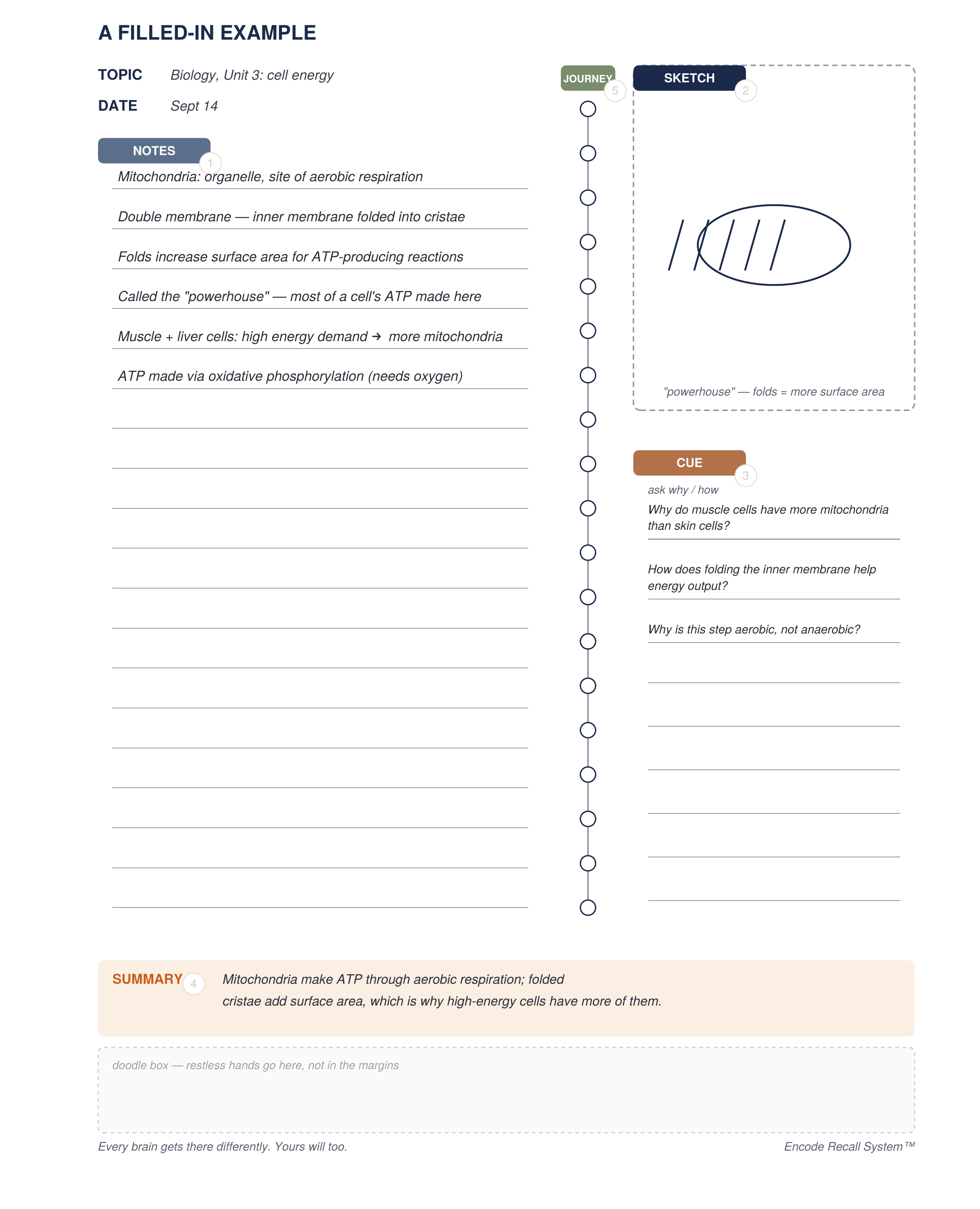
Open to a spread and move through the numbered areas. The page first helps you encode the idea, then makes you transform it, question it, compress it, and retrieve it again over time.
You can use one page for one concept or continue a larger topic across several pages. The labels remain the same, so the process becomes familiar even when the subject does not.
Make a difficult idea understandable in your own words.
See relationships that may be hard to spot in text alone.
Give yourself a question you can answer from memory.
Keep the central idea clear when you come back.
See where you have returned and what still needs attention.
Write the idea in your own words.
Use the Notes column for the explanations, relationships, facts, and examples that matter. Handwriting is slower than transcription, and that constraint can be useful: it pushes you to select, compress, and organize instead of trying to capture every word.
Why it is here: The physical format creates a focused place to select what matters, organize it deliberately, and explain it in your own words instead of simply transcribing the source.
Give the idea a second visual pathway.
Draw a relationship, process, diagram, symbol, timeline, or rough visual metaphor. The drawing does not need to look good. The useful work happens while you decide what the idea would look like and which parts belong together.
Why it is here: Wammes, Meade, and Fernandes found a reliable recall advantage for drawing across seven experiments, and the benefit did not depend on artistic quality. Visual distinctiveness and dual coding provide additional reasons to pair a sketch with written notes.
Turn notes into questions worth answering.
Write prompts that force you to produce the answer without looking. A useful cue is not merely “What is the definition?” It asks why something happens, how two ideas differ, what would change in a new scenario, or which principle applies.
Why it is here: Retrieval practice is one of only two study techniques rated “high utility” in Dunlosky and colleagues’ major review. Roediger and Karpicke found that retrieval practice improved long-term retention relative to repeated study.
Compress what you learned into a few sentences.
In a later session, write the smallest useful explanation of the topic. This is not a copied conclusion. It is a consolidation pass: what is the central idea, what connects the parts, and what would another person need to understand?
Why it is here: Ebbinghaus’s forgetting curve and its modern replication support returning to material rather than assuming one exposure will last. Summary gives that return a consistent place in the learning process.
Return later. Track what actually sticks.
Use the Journey trail to record spaced attempts to answer your Cue questions without looking. A correct answer today is useful. Correct retrieval across separate sessions is much stronger evidence that the idea will still be available when you need it.
Spaced retrieval has evidence from controlled studies. Your Journey record shows what you recalled across sessions and helps you choose where to focus next.Why three spaced successes? This benchmark comes from the spaced-relearning research family. Rawson and Dunlosky reported 68% one-week retention after one correct recall in each of three spaced sessions, compared with 26% after three correct recalls massed into one session.
A long trail is not a bad grade. It tells you this topic resisted learning and needed more returns. That is diagnostic information you would not get from rereading until the page simply felt familiar.
The system separates initial learning from later evidence of retention. You do not complete every action in one burst merely to “finish the page.”
Capture the idea in language, then translate its structure visually.
Build the questions that will test whether the knowledge can be produced later.
Return, retrieve the central meaning, and compress it before checking accuracy.
Use the cues without looking and let the trail show what has—and has not—stuck.
See the original learning studies and where the journal applies their ideas.